Part
VI --- A Meeting of Minds -- cont.
|
THE
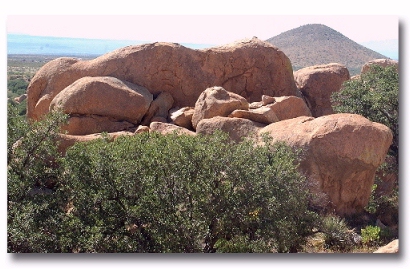
BIG ROCK
The
huge, saddle-shaped boulder at the back of this grouping is the "rock on
which peace was made" -- it is where, according to Tom Jeffords, Cochise
stood alongside the one-armed General O.O. Howard to announce to everyone
in camp that "it would be peace". It is also most probably the rock
where Cochise sat wrapped in his red blanket (given him by local rancher
Colonel Henry Hooker), smoking, keeping a lookout from a spendlid vantage
point that took in the entire San Pedro Valley -- and the place where Jeffords,
Sladen and Cochise spent hours in conversation while Howard was away at
Fort Bowie.
This
site has changed very little in the last 130+ years. |
CLICK
HERE FOR MORE INFORMATION ABOUT THE BIG ROCK, AND THE SITE OF COCHISE'S
CAMP
-
|
THE
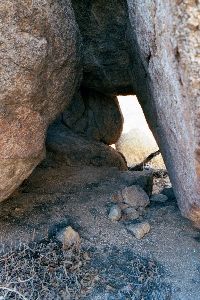
BOULDER CAVE
At
the foot of the "big rock" there is a space formed by the junction of two
large rocks large enough to comfortably shelter one or two people.
A small firepit exists inside this natural shelter (barely visible in this
shot, to the right of the squarish rock at photo center). The ground
left of the firepit seems to have been leveled more or less flat, and smoothed
out. It could easily provide sleeping quarters for one adult.
Cochise's
domicile? Perhaps one of them -- an idle spot to get out of the rain,
for example, or escape the rays of a hot Arizona sun. |
Shortly after
the group arrived at Cochise's camp, General Howard departed for his hard
ride to Fort Bowie with his young Apache friend Chie as guide. It
was by that time late in the afternoon. Sladen describes his growing
anxiety as he sat atop the big rock with Cochise and Jeffords, the three
of them watching the General and Chie growing smaller and smaller in the
distance as they made their way north, then eastward, eventually disappearing
behind walls of protruding rock along the Dragoon's westside foothills.
Sladen's discomfort was apparent to Cochise, who made an effort to put
the young captain more at ease.
The Chief displayed the wry humor that seems
to have gotten lost in all the history books. According to Sladen:
|
Something of my feelings must have unconsciously found expression in my
face, for Cochise said to Jeffords, though partly addressing me in a laughing
way: "Capitan triste [sad]!" "No," I said to Jeffords, "tell
him that I am not blue at all, that I was only thinking." This was
translated to Cochise, who said, "Si, si, Capitan triste!"
"Tell him," he said to Jeffords, "not to feel triste. He can make
himself comfortable here; he can leave his saddle in one place, his blanket
in another, and his pistol in another, nothing will be lost; this is my
Camp; I command it."
After seeing my face light up with a smile as Jeffords translated all this
message to me, he added, "Tell the Captain that I will send off and get
some tiswin, and we will all get drunk and have a good time tonight."
"Making
Peace With Cochise" -- the journal of Joseph Alton Sladen, edited by Edwin
R. Sweeney -- buy the book click here!
|
As for Howard, the
day was to be a very long one. He gives us a good account of the
harrowing journey in his 1872 article, from which the following is taken:
|
" . . . but as the night came on we lost the trail and scrambled over rugged
heights and through deep canons such as I would not have undertaken in
daylight. I tore my coat almost to shreds, pricked my limbs with
throns, and began to be fearful that we should be obliged to remain in
the mountains all night. But the young Indian never flagged.
He would occasionally exclaim, "General, camina no bueno;" then we would
try again, probing in another direction; occasionally I would hug the mule's
neck while we ascended a precipitous height, or pull him after me along
the sides, almost too steep to stand upon, and occasionally pass down to
the bottom of the canon by sliding with him down six or eight feet.
We would be going along bravely in the canon when the leading mule would
plant his feet on the brink of a precipice twenty or thirty feet in height,
then back we would turn, regain the mountain side, work past the precipice,
and slide down again. My Spanish was meager and poor, and Chie's
no better, and his English still worse. In fact, the only English
words I ever heard him say were "Yes, sir" and "milka way." No word
of impatience escaped either of us, yet when we emerged upon the plain
we each began to sing in our respective languages with considerable gusto."
From
Howard's 1872 article, "Account of General Howard's Mission to the Apaches
and Navajos", published in the Washington Daily Morning Chronicle, November
10, 1872. |
They stopped at
Nick Rogers' Sulphur Springs station (the same building that would soon
become Jeffords' first agency) where they were able to procure two fresh
mules and enlist Rogers to take them on to Fort Bowie with a cart wagon
in tow, which they would fill with provisions before returning the next
day to Cochise's camp. In Sladen's journal we find a rollicking account
of General Howard's return that would be right at home as a bit of comic
relief in a Hollywood movie. He, Jeffords and Cochise had been watching
for the return of the General and when a large party was spotted by lookouts,
they all rode to meet the approaching group in a pass that cut through
the Dragoons (almost certainly the pass that present day Dragoon Road cuts
through on its way to intersect with Interstate 10). The advancing
party, to Sladen's delight, consisted of all the men they had had to part
with earlier, and a heavily stocked wagon which was being driven by Bloomfield:
|
"The four fat mules of our team excited the greatest admiration and curiousity
on the part of the Indians, and some of the more venturesome pertinaciously
insisted on getting on the seat, taking the reins in their own hands and
driving the team. This they did at the top of their speed and with
such a reckless disregard of all obstacles the wagon had a narrow escape
from upsetting several times, till, at last Bloomfield, a cranky, obstinate
old German angrily pushed them off and took the reins himself. The
Indians were inclined to resent his rought and angry manner and it looked
for a few minutes as if serious trouble might result, but the approach
of Cochise and the General put a stop to the difficulty."
"Making
Peace With Cochise" - the journal of Joseph Alton Sladen, edited by Edwin
R. Sweeney |
This return, however,
did no occur for two days (General Howard left for Fort Bowie on October
1st and returned on the 3rd), and in the meantime Sladen's and Jeffords'
stay in camp was anything but dull. |
 .
. . . .
.
. . . . .
.

