 .
. . . . .
. . . . |
 .
.
|
.
. . . . |
| Part
VI --- A Meeting of Minds -- cont.
PANIC IN THE NIGHT
Until General
Howard's return, which was not to take place until the next day, Cochise
had no way of knowing if the American Army had agreed to curtail operations
while the peace talks could go forth. Sladen writes of an occasion
wherein one of the warriors returned with news that angered Cochise to
the point that he struck the man a blow that sent him to his knees.
Almost immediately the entire camp began preparing to move. Sladen
and Jeffords asked no questions and were given no excuses, but by nightfall
they were on horseback following Cochise's entire band up into the fastness
of the Dragoons. They traveled for some time in near total darkness
when the signal was given by Cochise to stop and dismount, at which time
everyone, though situated on steep grade and without a flat spot to be
found, awkwardly attempted to bed down for the night.
It was later determined
that the returned warrior had slain an American before getting word of
Cochise's orders to return to camp, and Cochise had no choice but to move
his band into a more easily defended location in the event soldiers had
already been sent to punish them. Sladen learned that this was the
manner in which Cochise's people had been living for several years; always
fearful of surprise attacks principally from the troops at nearby Fort
Bowie.
THE RETURN OF GENERAL HOWARD - THE PEACE TALKS BEGIN
On the third of October General Howard returned from Fort Bowie bringing with him a wagon load of supplies and all the members of their original party who had been diverted to Fort Bowie six days earlier. By this time a few of Cochise's men had returned, but Cochise had told Howard that he could not decide the matter without first discussing it with as many of his captains as could manage to return in a period of ten days. On October 11th, the last of Cochise's men save one had returned to camp. Unfortunately the one that had not received word was probably one Cochise would have dearly loved to include in the conference; his eldest son Taza, who had been raiding in Mexico and was not within reach. A word here concerning the depiction of this peace conference in the popular movie, "Broken Arrow". As is sadly true of the bulk of "historical movies", Elliot Arnold's screenplay played fast and loose with the facts, unlike his novel on which the movie was based. For dramatic affect the movie includes Geronimo in this cast of characters who, if he was present at all, was certainly not a voice in the matter since at that time he was by no means an important Chiricahua warrior. Sladen concluded that one particularly surly fellow who was present amongst the returning captains was probably indeed Geronimo, but Edwin R. Sweeney feels that a better case can be made for this unlikeable fellow having been an Indian known as El Cautivo, who was regarded by Cochise as an important advisor and translator (El Cautivo in Spanish means "the captive" -- he was once captured by Mexicans and had mastered their language). Geronimo's discontent with the Americans and the reservation system did not flower until after Cochise died and the Chiricahua Reservation was closed, and his personal involvement with Cochise, while not well documented in any sense, was most likely as an on-again off-again band member, as Geronimo had more a history with Mangas Coloradas (Cochise's father-in-law) than with Cochise. Once the captains returned, talks ensued amongst the Indians, while Jeffords, Howard and Sladen were obliged to wait patiently. This must have been a time of great anxiety for Howard in particular, though he was adamant always that he possessed great confidence in the outcome. Sladen was notably less certain and he makes his nervousness known in his journal. Other times General Howard was involved in the talks and he apparently had some difficulty convincing some of Cochise's men of the advisability of turning to peace -- somewhat as depicted in the film discussed above. It was during these attempts that he finally abandoned all hope of selling them on Cañada Alamosa and agreed to give them much of the country they already called their own. Howard makes an interesting comment in the article he wrote a month after his return from the Dragoons in which he describes a "prayer meeting" that Cochise conducted amongst his people as these talks progressed. Howard wrote that this meeting took place in a "curious little nook some fifty yards up the mountain". I have tried to find a likely candidate for this position and find that it well describes the area up behind the "big rock" part of Cochise's camp, where the slopes of the Dragoons begin to grow steep and very rocky. A massive wall of granite leans slightly inward, forming something of an enclosed space similar to a grotto -- which might be termed a "nook". It is also possible that it is this small area that Jeffords, Sladen and Howard refered to as "the cathedral" (see the section "Cochise's Camp Rediscovered"). Word came down from
this meeting that Cochise's people had considered the matter very carefully
and had decided upon peace. Once the decision had been made, the
change amonst the people of Cochise's band was, according to both Sladen
and Howard, dramatic. It was as though a great weight had been lifted
from the shoulders of all in camp and the overall mood was one of great
joy and there was a good deal of laughter. Immediately it was decided
that the treaty would be formally cast the next day at Dragoon Springs,
near the abandoned Dragoon Springs stage station (the station had been
on the Butterfield stage route and was hastily abandoned when Cochise launched
his war against the Americans). Word was sent to Fort Bowie and Cochise
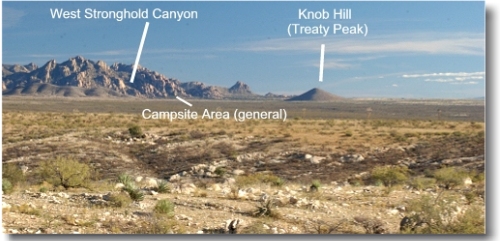
directed Jeffords and the young Indian Chie to climb nearby Knob Hill and
hoist a white flag so that all within view of it would know that Cochise
had come to peaceful terms. This hill is directly west of the campsite,
out on the flat plain that leads down to the San Pedro River, and is today
known as Treaty Peak. It can easily be seen today from Interstate
10 just west of Texas Canyon, standing like a huge ant hill on an otherwise
table-flat floor of desert.
|
|
|
|
|
|
|
THE MOVIES |
|
REDISCOVERED |
-
*
* *